
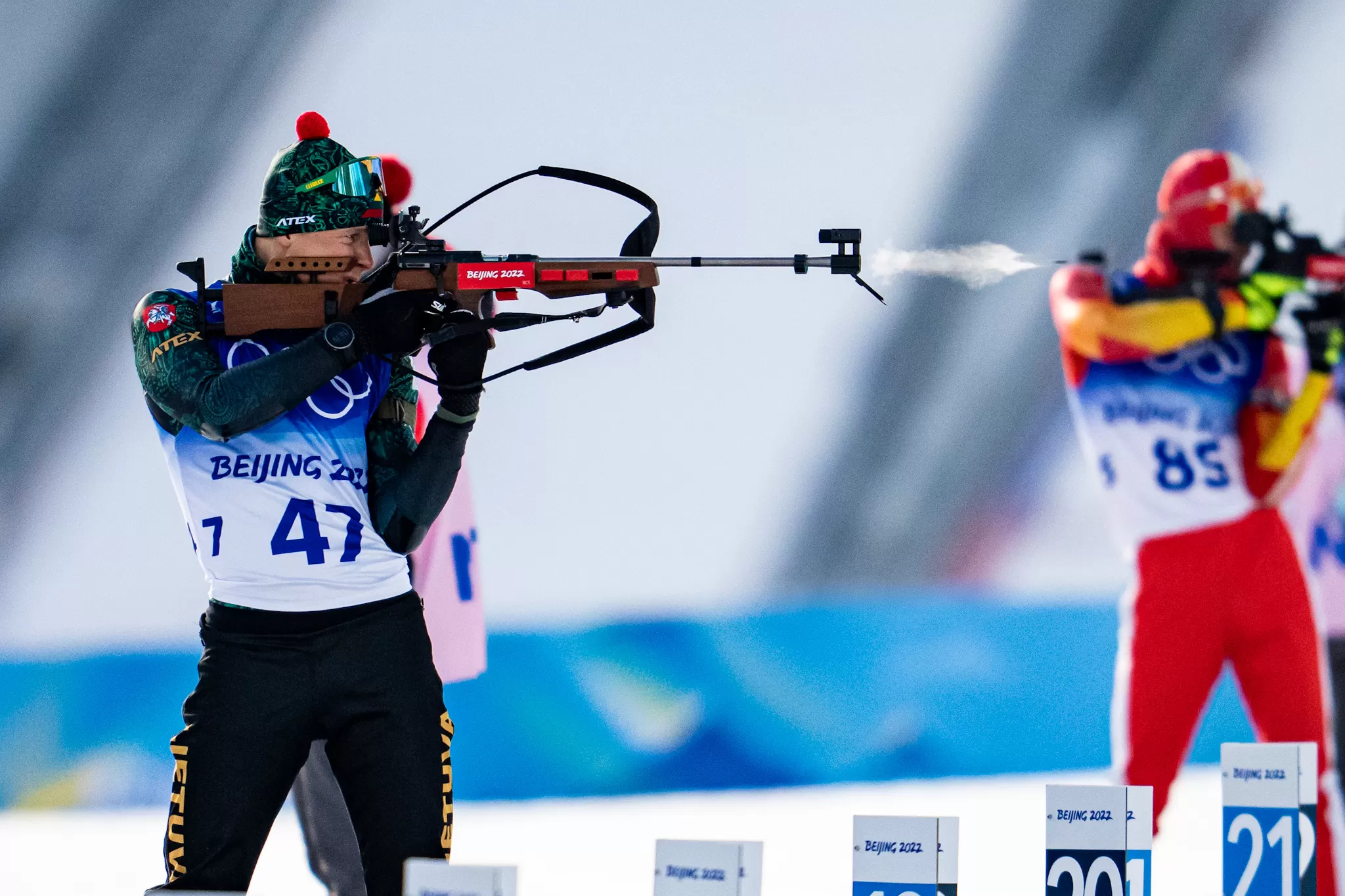
Lithuanian biathlon legend Tomas Kaukėnas is turning the last page. On Sunday at the World Cup stage in Oslo the 35-year-old will take part in a special ceremony in which he will complete a symbolic lap with other biathletes who are ending their careers this year.
T. Kaukėnas took part in three Olympic Games, represented Lithuania at 12 World Championships and stood on the start line of World Cup races as many as 264 times.
“I completed my mission as an athlete,” T. Kaukėnas smiled.
He wanted to be the best version of himself, not the best
T. Kaukėnas started his biathlon journey in Ignalina at the age of nine. Coach Aleksandr Shchechochikhin, who came to the school to present the sport, lured the fourth-grader with shooting.
“The whole class reacted ‘wow, they shoot’ and all of us classmates went to try. There was a feeling of being part of a crowd, I wanted to shoot, to have a good time, because the training was interesting, without heavy loads. I did not think about results until about the age of 16, when I went abroad for the first time – to Madona in Latvia. International competitions took place there and that is when it sparked in me that I wanted to see as many countries as possible. That thought led me to the World Championships in Nové Město, and only then did I think that high results could be pursued,” T. Kaukėnas recalled the beginning.
But on the biathlon track the slightly built Ignalina athlete did well: the Lithuanian quickly became one of the strongest on the planet among his peers. At the 2009 World Youth Championships in Canmore (Canada) he took 8th place in the sprint, even after three penalty loops. A few days later, in the pursuit race, T. Kaukėnas narrowly missed winning Lithuania’s first medal, finishing fourth.
The future star of the country’s biathlon also did well in the junior category: in the sprint at the 2010 European Junior Championships he was eighth, and the Ignalina athlete took the same position at the 2011 World Junior Championships. It became clear that independent Lithuania had not yet seen such a capable male biathlete. Even so, T. Kaukėnas himself did not set himself the goal of fighting for the highest places, even at junior championships.
“I had no desire to win first place. I simply trained, took part and did everything I could do best, without the ambition to win. I think that helped me then, because when the desire to show results appeared, they started to drop. Algimantas Šalna once said ‘I wanted to be the best’, and I never wanted to be that: I wanted to perform as well as I can, to be the best version of myself, not the best in the world,” said T. Kaukėnas.
Success was brought by an “outdated” methodology
T. Kaukėnas made his World Cup debut in 2009 in Ruhpolding (Germany), and his World Championships debut was the 2011 championships in Khanty-Mansiysk (Russia). There the 20-year-old Lithuanian took 59th place in the sprint and earned the right to start in the pursuit, where he became the youngest participant of this event.
The most successful World Championships of his entire career were the 2013 championships in Nové Město na Moravě (Czech Republic): 21st place in the sprint and 23rd in the individual race allowed him to break into the prestigious mass start, in which only the 30 strongest biathletes on the planet take part. In the whole history of Lithuania only Diana Rasimovičiūtė and T. Kaukėnas have taken part in this event at the World Championships, and he took 28th place.
“It was really unexpected at that time. I consider myself a realist, although many consider me a pessimist. Back then my shooting was stable and I did well in that area. The way Vytas (Strolia – author’s note) does well in Ruhpolding, that is how I did well in Nové Město. At that time the coach was Viktor Korchagin from Belarus. Although his methodology seemed outdated, he built the base then. We did not do big and intensive training, but during competitions I would get going and show the result where it was needed. That strange methodology let me perform at the most important competitions,” T. Kaukėnas said.
In the biathlete’s opinion, an important component was that the Lithuanian team could then skip World Cup stages and devote more time to preparing for the most important starts of the season.
“Later the federation’s strategy changed, because we started fighting for the overall World Cup standings, so we had to take part everywhere and always. Before Nové Město we had the luxury of skipping World Cup stages and specially preparing for the main competitions, which later no longer existed,” T. Kaukėnas explained.
He shone at the Olympic Games
Nevertheless, the biathlete, who now lives in Vilnius, shone most brightly at the Olympic Games. In 2014 in Sochi (Russia) T. Kaukėnas was close to the biggest sensation of the 20 km individual race: the Lithuanian, who made no mistakes in three shooting stages, reached the fourth with the second-best result among all participants. Three misses there dropped him to 23rd place in the standings, although accurate shooting would have guaranteed a silver medal – the first in the history of independent Lithuania.
“No bitterness is left, I am glad that during my career I managed to be in good form at least once. At that time I really did well on skis, they glided very well, I enjoyed the Games, I was elevated, because they were my first. When the emotions are good, all the hormones are at a high level. I remember it as a really good Games, although after the individual race it was sad. Now it seems that the result was really good and was not planned,” T. Kaukėnas said.
Four years later in Pyeongchang (South Korea) the leader of the Lithuanian team managed to write himself into the country’s history by achieving the highest places by a Lithuanian biathlete at the Olympic Games so far. The then 27-year-old was 17th in the sprint and 13th in the pursuit. In addition, T. Kaukėnas became the first Lithuanian to compete in an Olympic mass start race – there the representative of the Vilnius club “Instinktas” finished 30th.
“I was a really mature athlete and the results were not accidental like in Sochi. I went to Pyeongchang psychologically strong, I worked with a psychologist all year before the Games and knew what I needed to do. I felt very calm and I feel that it was the result of my work on myself. At that time coach Meelis Aasmäe sensed me very well and did not put unnecessary pressure on me. I felt that there were specialists next to me who supported me and believed in me. It was the most mature Games and the most mature performance of my entire career,” T. Kaukėnas summed up.
Another four years later, at the Olympic Games in Beijing (China), the biathlete also contributed to another historic result, taking 14th place with the men’s 4×7.5 km relay team. These Games were the last of T. Kaukėnas’s career.
Distraction got in the way of results
After the 2018 Pyeongchang Games T. Kaukėnas made it into the top 40 only twice: in 2019 at the World Cup stage in Östersund (Sweden) he took 31st place, and at the 2023 World Championships in Oberhof (Germany) – 34th. What caused the deteriorating results?
“Perhaps the problem was that our coaches kept changing, and you have to adapt to every change. When the new coach came, we first found a common language, but the post-Olympic year was very hard for me, I fell ill and found it hard to recover. The new coach did not know me, we sort of agreed to reduce the loads and return to feeling good, but I could not get back to it. The coach lost faith in me, I lost faith in the coach, and a period of distraction began. The key thing is that I started to be distracted and the purposeful work that used to be there was gone. I do not blame the coaches, I made the decisions whether to keep training with a coach or look for something else,” T. Kaukėnas said.
During his career the biathlete was coached by Aleksandr Shchechochikhin, Edvardas Rasimovičius, Belarusian Viktor Korchagin, Latvian Ilmārs Bricis, Estonian Meelis Aasmäe, Belarusian Sergey Sokolovsky, and in the last years by Diana Rasimovičiūtė and Stanislav Sabaliauskas. The latter also coached the athlete for some time when he was in the youth team.
“A. Shchechochikhin and E. Rasimovičius are my first coaches, they shaped my attitude to sport and I will never forget them. They gave a great deal, invested in me, once even treated a cavity at their own expense, because otherwise I could not go to a camp and it had to be treated urgently. The coaches saw my potential and I felt that they needed me. Later came V. Korchagin, who brought a system to Lithuanian biathlon, he fought for us, for order in the federation, and I felt that we had a representative who cared for us, although our views differed because of age. Ilmārs has huge experience, he gave the most attention to Diana (Rasimovičiūtė), because she was the team leader, but I did not feel abandoned and those working years together were good,” T. Kaukėnas described his coaches.
The biathlete achieved his record places in Pyeongchang under M. Aasmäe: then not only T. Kaukėnas shone, but Natalija Kočergina also performed successfully at the Games, and Lithuania had a (mixed) relay team at the Olympic Games for the first time.
“I liked Meelis because he is quite free, he supported my ideas, I do not remember anything in his methodology that I did not like. Later, when S. Sokolovsky came, our views did not match and that became the start of the distraction. The last years, when S. Sabaliauskas and Diana coached me, were among the best, because those people believed in me when no other coach believed any more. That is much more important to me than the results achieved with them. A good relationship is the key to good results,” said T. Kaukėnas.
He ends his career but is not leaving biathlon
It is no surprise that the most memorable competitions of his career for T. Kaukėnas were the sprint and the pursuit at the Pyeongchang Olympic Games.
“As I finished I was surprised by my form. That emotion after the finish, Vytas was happy, Ruslan (Nikitin – author’s note), Vida Vencienė, Daina Gudzinevičiūtė and Einius Petkus shouted and cheered in the stands. Those competitions stayed in memory – the highest place, the best form. On the course I felt similar to Sochi, only the emotion after the finish was better than in Sochi,” T. Kaukėnas said.
Lithuanian biathlon legend D. Rasimovičiūtė, who ended her career in 2019, once said that her real biathlon ended four years earlier. Are her story and T. Kaukėnas’s similar?
“Diana said that? Really, I would never have thought… I would agree with Diana, already after Beijing somewhere deep inside I understood that this was it. At one point I let the thought go that I could still show good results, perhaps that thought determined what I have now. It seems that in the last years I was in biathlon not for my own result but to help the team. I wanted to do everything so that the team had a good atmosphere, for example at one of the camps in Finland I organised a party where we danced until 11 in the evening,” T. Kaukėnas laughed.
The athlete finishes his biathlon path with a calm heart but does not intend to move away from biathlon – the Vilnius native wants to become a coach.
“I leave with a calm heart, I feel that we have a successor generation that can represent Lithuania without me. One colleague said ‘coach, how do I know when it is time to end my career’, and the coach answered him ‘don’t worry, the younger athletes will whisper it to you’. The younger athletes have already whispered to me that the time has come. Young athletes burn for it, and in me there is no burning left, everything that could burn has burned (laughs – author’s note). I completed my mission as an athlete, but the mission in biathlon does not end, there will be another stage, perhaps not as an athlete but as a coach. I have been in biathlon for two thirds of my life, changing something would be very hard, I know the whole kitchen, so I plan to start with coaching children, and what comes next, we will see,” T. Kaukėnas closed the page of his biathlon career.
Author: Robertas Trakys
Photo: Vytautas Dranginis/LTOK