
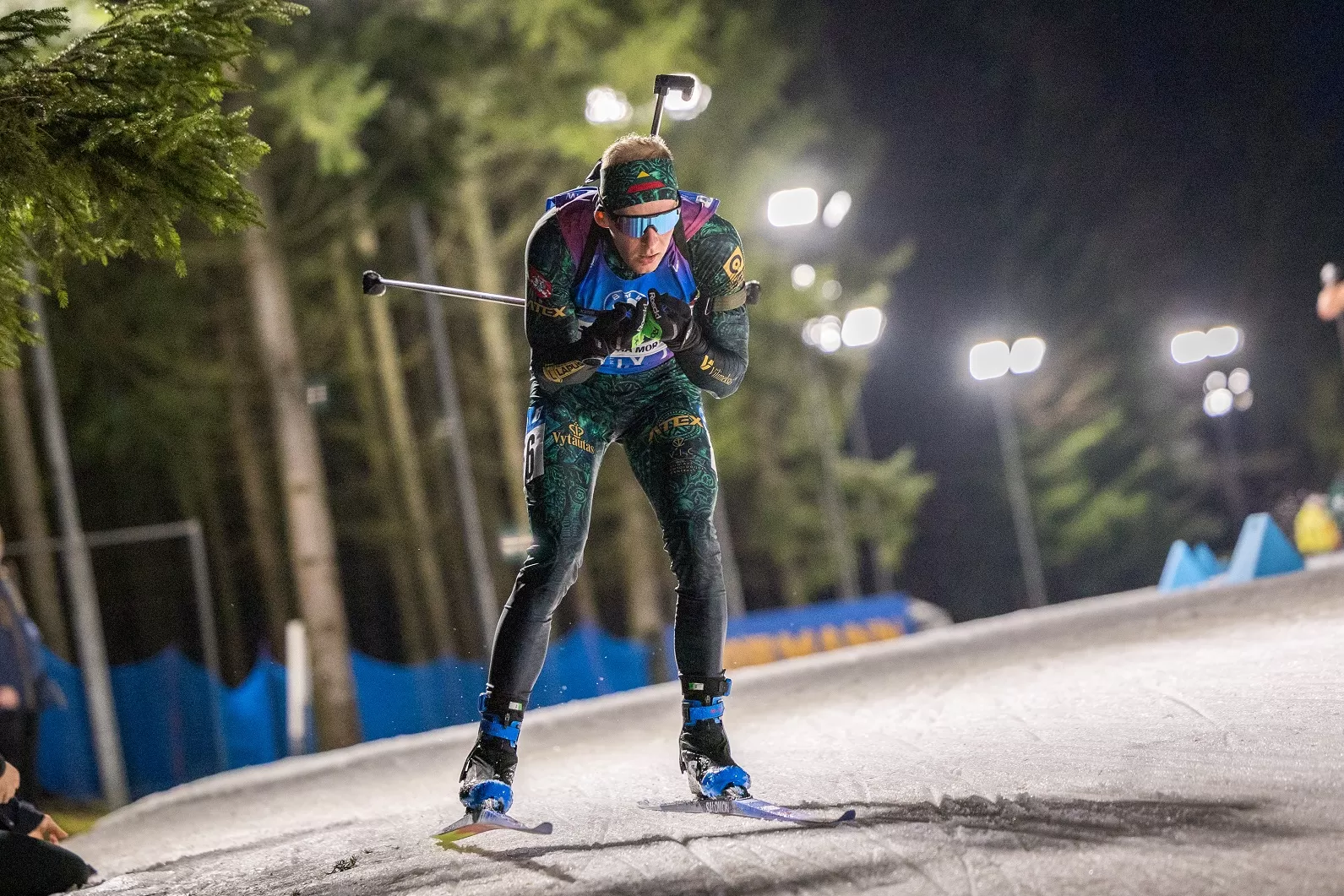
On Saturday in Kontiolahti (Finland) the 2024–2025 Biathlon World Cup season will begin, and with it the selection for the 2026 Milano-Cortina Winter Olympic Games. The Lithuanians, who had a record delegation of five biathletes in Beijing two years ago, have no doubt that a new record will be set at the Games in Italy’s Alto Adige region and that at least 6 athletes will represent Lithuania there.
92 – at most this many biathletes will be able to start in one Olympic event. 20 countries, according to the 2024–2025 World Cup season Nations Cup standings, will be able to send full relay teams (4 athletes each). Another 12 individual quota places will go in January 2026 to the best representatives of the countries that remain outside the top 20.
“This year is important for us because the selection for the Winter Olympic Games is already beginning. The maximum goal for both the men’s and women’s teams is to get into the top 20, which would guarantee them team participation at the Olympic Games. If the men’s team has not dropped below 18th place in the Nations standings over the last five years, then the women’s success will depend on how quickly the fourth athlete meets the World Cup standard and so contributes to collecting points in relays,” said Arūnas Daugirdas, President of the Lithuanian Biathlon Federation (LBF).
At the World Cup stages the country will be represented by 24-year-old Judita Traubaitė, 25-year-old Lidija Žurauskaitė and 39-year-old Natalija Kočergina. Last season all three athletes coached by Ruslan Nikitin managed to make the top 60 in the sprint and take part in pursuit races, and L. Žurauskaitė even won points. Sara Urumova and youth team representative Viktorija Augulytė are contending to become the fourth member of the team, who can earn the chance to start in the World Cup in IBU Cup races.
“We know that our competitors are not asleep and it will not be so simple to achieve the set goal. If the girls did not manage to get into the top 20, we hope that at least two girls could win individual quota places for the Games. This task is achievable, because preliminarily we can compare ourselves with rivals from competing countries. Even 3 of our girls are really capable of fighting for individual Olympic quota places,” said A. Daugirdas.
The past season was unsuccessful for the Lithuanian men’s team, which slipped to 18th place in the Nations Cup standings and lost one quota place in World Cup races. True, team leader Vytautas Strolia shone at the World Championships, taking 15th place in the individual race.
“We hope that Vytautas will recover from the consequences of the illness (mononucleosis – author’s note) that tormented him for a year and be more stable. We would really like Maksim Fomin to provide him with competition and to assault the points more often, and, if his health is in order, Karolis Dombrovskis too. We hope that three-time Olympian Tomas Kaukėnas also still has some powder left,” said A. Daugirdas.
After last season the coach who had led the team for six years, Sergey Sokolovsky, said goodbye to the team. The helm was taken over by Fyodor Svoboda, who had previously worked with the Estonian and Belarusian teams. In the first stage in Kontiolahti the Lithuanian team quartet will consist of 32-year-old V. Strolia, 33-year-old K. Dombrovskis, 34-year-old T. Kaukėnas and 24-year-old M. Fomin, but this line-up may change after the first starts of the season, since as many as nine Lithuanians have met the World Cup qualification.
“We will definitely vary the line-up, we have already given the whole team to understand that. The starting line-up of the season was made based on experience and the performances of the last few seasons, and in the second and third stages rotation is already possible depending on the athletes’ results,” said A. Daugirdas.
The World Cup season will consist of 9 stages. The European Championships will take place on 29 January–2 February in Martell (Italy), and the World Championships on 12–23 February in Lenzerheide (Switzerland).
Author: Robertas Trakys
Photo: Dmytro Yevenko